Session F6
This session will work on team defence strategy.
Preparation: Use cones to set up one field for every ten participants (25m wide, 35-40m long goal-to-goal, plus 12-15m long endzones). These fields can also be used as playing areas for activities.
Introduction
- Set the expectations for the session – area and equipment used, and what skills will be taught
- Outline any safety considerations for the session
Warm-Up
Skill – Force Thrower to Fixed Side
The most common team defence strategy in ultimate is called a “force”. This is applied by the marker attempting to force the thrower to only pass to one side of the field, while the guarders position themselves on that same side of the field in order to prioritise guarding that space.
This strategy is used to conserve energy on defence. By splitting the field in two and dividing responsibility for each side to different roles, defenders aren’t tiring themselves out by trying to cover the entire field. It also tries to get the offense to play close to a sideline, risking passes going out of bounds.
This strategy is determined before the point – the team will pick a side of the field to “force” offence to play down with a visual cue. Eg: “force pavilion side”, “force road side”
Instead of standing in front of the thrower, the marker will stand to the side of the thrower. They should imagine they are pushing the thrower to the force side, and are perpendicular to the thrower’s hips.
In this photo, the black team is on offence, aiming towards the camera. The white team is forcing them to play to the left (thrower’s right). Note that the marker is positioned side-on to the thrower, and allowing them to pass down the force side, because her teammates will be actively defending that space downfield.
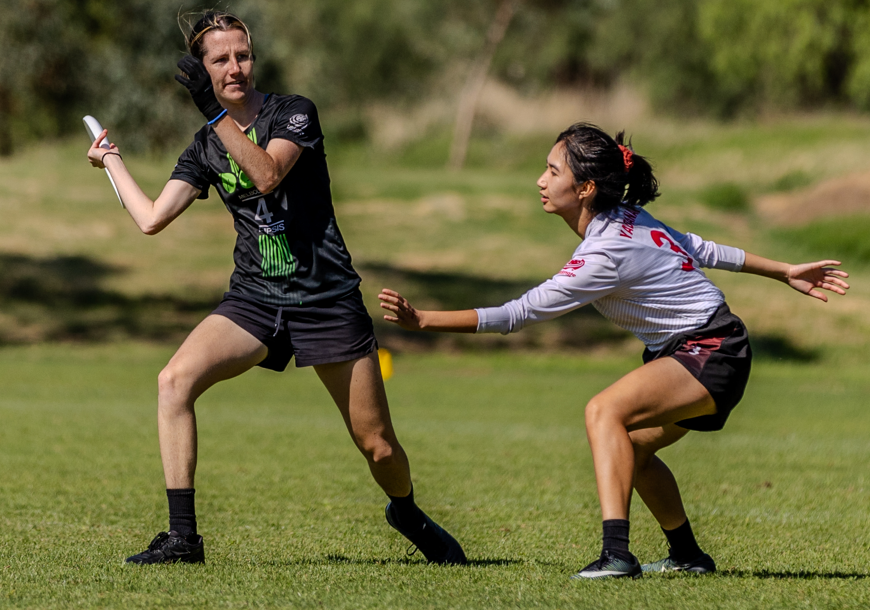
To practice applying a force as a marker, use four-person variant of the Thrower Marker Drill
Activity – Force Cutters to Fixed Side
When guarding cutters downfield, guarders should position themselves on the force side of the field relative to the disc – they should be imagining leading the cutter to the force side.
In the photo below, the blue team on offence is throwing away from the camera. The red team marker is forcing the thrower to the right side, so the two guarders ahead of the disc are positioned on the force side of the cutters to defend that side of the field. They are trusting that the marker will not let a pass out to the break side.
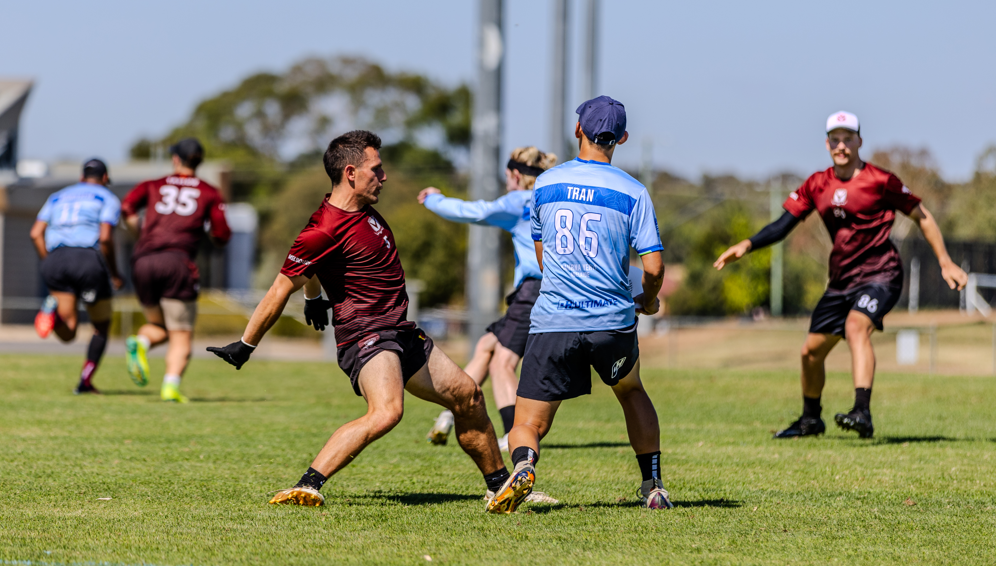
Splitting the field
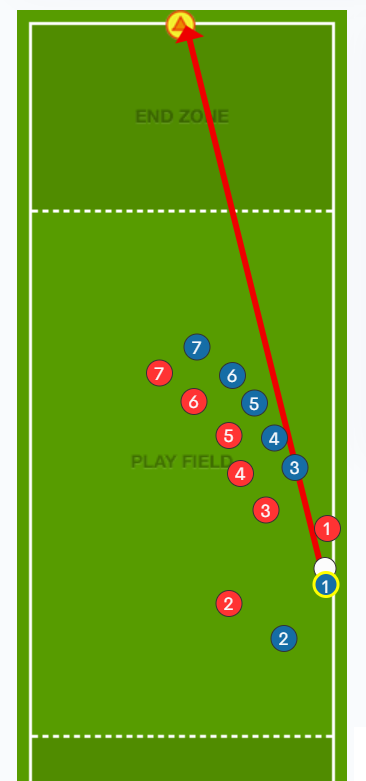
To split the field between the “force” side and “break” side, place a large prominent object (eg: cone, chair, pole, bin) at the middle back of the endzone. Players should imagine a line being drawn between object and the disc to split the field. This line swings back and forth as the position of the disc changes like a pendulum.
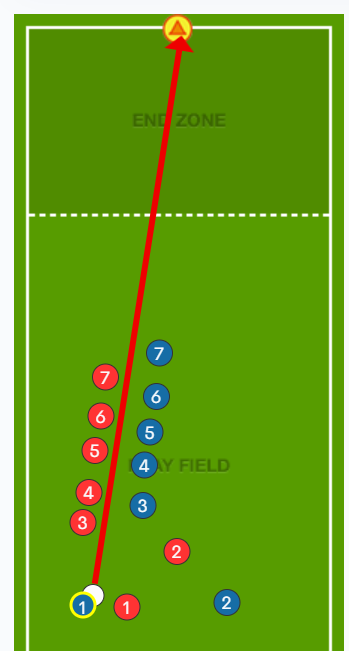
In this diagram, blue is on offence, throwing towards the top of the image.
Red is on defence, and is forcing the blue team to the left side of the field.
The marker is on the right side of the pendulum, perpendicular to the thrower, forcing them to throw to the left.
The guarders are all on the left side of the pendulum, relative to the cutters they are guarding.
Defender #2 sees that the marker can block off throws to the backfield cutter they are guarding, so can stand off them and plug any gaps to the break side they can see.
Below are examples of how the pendulum and positioning changes depending on where the disc is.
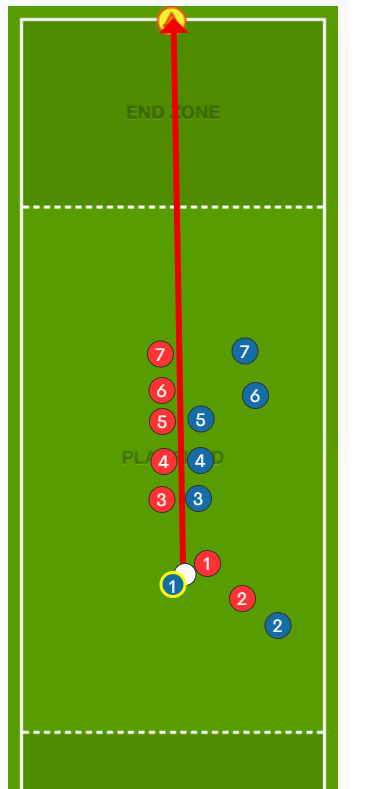
Note how even if cutters are on the break side, guarders are still on the force side of the pendulum. And if the cutters come over to force side of the field, the guarders still stay on the force side of them.
Obviously cutters can still outrun or outsmart guarders, and sometimes throwers will still get passes to the break side of the field, but this strategy is the most efficient and effective way to earn turnovers.
Over time and with repetition, players will develop enough spatial awareness to no longer need the visual aid at the back of the endzone, and simply use the endzone cones as bearings.
To practice this, set up a game situation on the field. Have three throwers spaced across the backfield, and 1-2 players acting as the vertical stack. Designate one defensive player as a marker, with all the others are guarders.
The three backfield offense players pass the disc back and forth on the coach’s signal, one throw at a time on the coach’s signal. After the throw, the coach calls “up”, which prompts all defence players to look around and make the following decisions:
- Can I get the intercept? If they can safely get the intercept, they should go for it, otherwise move on to the next question.
- Where is the disc going? Which offense player is likely to catch it. If it is the player they are guarding, they then prepare to become the marker, otherwise move on to the next question.
- Where is the pendulum? Once catch is made, the marker should be on their side of the pendulum with a marker stance, and guarders should be on the other side of the pendulum.
Once everyone is set, give a signal for the next throw. Players will need time to do the above checks and set themselves in position when they first learn this, but should become more comfortable and efficient with ongoing reps.
Variant: after every throw, the marker switches back to guarding, and a new guarder comes to the throwers while the disc is in the air. This will require cooperation and communication between defenders.
Variant: attackers float around the field, and can move while the disc is in the air. After the catch, guarders need to be on the correct side of the pendulum AND the cutter they are following.
Optional Progression – vocal communication on defence
If players are comfortable with the above concepts, introduce verbal communication. During competitive games of ultimate, defenders are continually talking to each other to apply team defence, rather than just chasing cutters around.
Players on the sideline can also contribute to team defence by communicating to their teammates on the field.
Common verbal cues by defenders and sideline players are:
- “Up!” – the disc is in the air. Rather than the coach calling this in the Pendulum activity, encourage defence players on the field to make this call for their teammates.
- “Break!” – alerts guarders that a pass has been thrown around the marker, and the non-force side of the field (the “break” side) is now exposed. Guarders should try to move across and temporarily block passes to that side of the field until a marker can re-establish a force again.
- “No huck!” – a “huck” is a slang term for a long throw to the endzone. If a cutter has lost their guarder and is heading towards the endzone, this call is made to the marker to temporarily (1-2 seconds) move in front of the thrower to prevent long throws until the guarders can cover the loose cutter.
- “____ left” or “____ right” – prompts the marker to adjust their position based on where backfield players are positioned, or if they are out of line with the pendulum. This is called as either “marker left”/ “marker right”, or using the marker’s name.
Keeping these calls simple makes it easier for defensive players to listen out for and react to the information.
The approach to these calls is that they are information for the defenders, not instruction. There is a lot to think about during live play for defenders – they might have their own plan, they might see something their teammates can’t see, or they simply might not hear the call. By emphasising that the calls are simply information instead of instruction, this avoids frustration developing from teammates not reacting to the calls.
Strat Chat
Recap why to use a force strategy on defence
- To play defence as a whole team, rather than as individuals
- To conserve energy by splitting the field in two and only guarding one side
- To make offence play close to a sideline, risking a pass going out of bounds
Terminology
- “Force” side – the side of the field we will try and make offence play down. Markers should “push” throwers to the force side. Guarders should “lead” cutters to the force side to give themselves positional advantage once a throw is in the air.
- “Break” side – the opposite side of the field. The marker is trying to prevent passes to the break side, but allows passes to the open side.
What decisions to make on defence when a pass is made
- Can I get the intercept?
- Where is the disc going?
- Where is the pendulum?
How can players on the sideline contribute to the game?
- By providing verbal information to their teammates on defence.
Play Ultimate!
- Keep teams small – no more than five per side on the field
- Make an effort to ensure everyone is involved
- Use the CHANGE IT sheet to make adjustments if needed
Finish up
- Ask participants to return all cones and discs
- Thank them for playing!
- Tell them about the Ultimate Victoria website to find out more about the sport